
Why complex functions are amazing
A primer into complex analysis!

One of my favorite subjects in undergrad was complex analysis.


While real analysis felt technical and unwieldy, complex analysis felt pristine. All the proofs were short and elegant. The theorem statements were clean and powerful.
But out of all the theorems I learned in complex analysis, three of them stuck in my mind. I want to share them with you.
Fact #1: once differentiable means infinitely differentiable
If a complex function is differentiable once, it is differentiable infinitely many times.
This is completely false in real analysis.
There are many functions which are differentiable once but not twice. An example of such a function is
at the origin (where we set f(0) = 0). See the picture below.
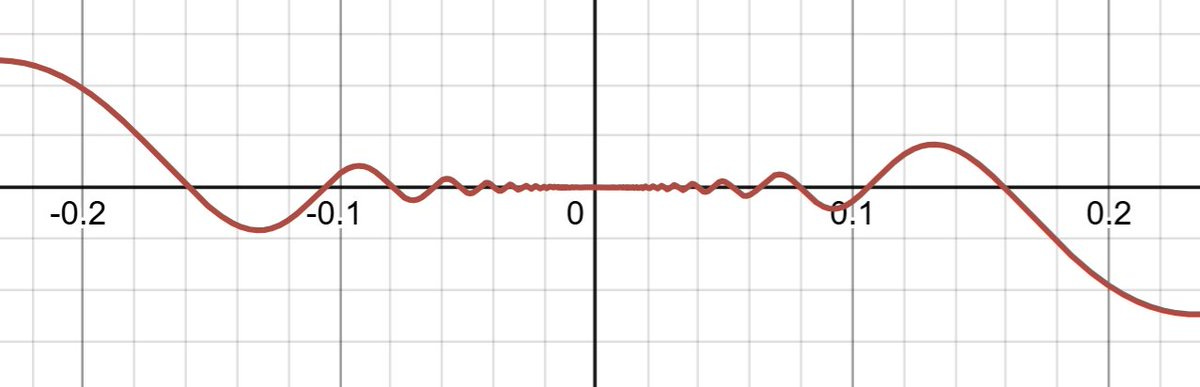
This is never the case in the complex world.
Fact #2: Liouville’s Theorem
If a complex differentiable function on the complex plane is bounded, it is constant.
This is incredibly startling!
And it is completely false for real functions — for example, sin(x) is bounded and non-constant.
But the complex sine function (pictured below) is in fact unbounded in the imaginary axis of the complex plane!

Fact #3: Identity Theorem
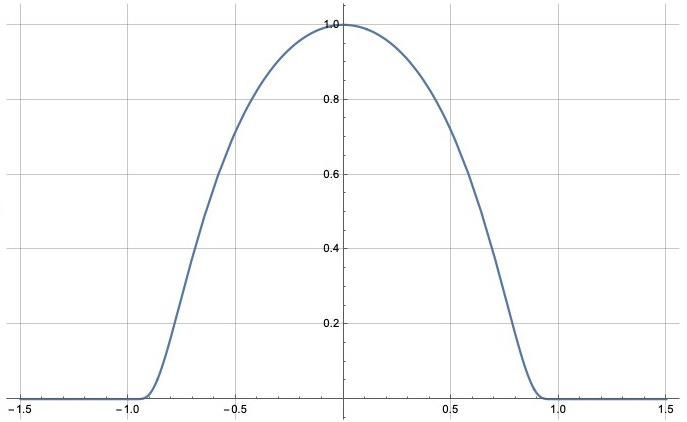
If a complex differentiable function on the complex plane is zero on an open subset of the complex plane, it is zero everywhere.
Again, this is totally false for real functions. There many smooth real functions which are zero on an open interval but not zero everywhere, e.g: the graph below.
Problem of the week
Here is the challenge problem for this week:
Prove that if x,y,z are real numbers from [0,1], then
Got a solution to the challenge problem? Submit it here.
Thanks for reading and happy learning! Until next time,
Adithya
Hi Adithya! Thanks for your post — you've whet my appetite! :)
Do you have any recommendations for books for learning Complex Analysis? I've just done a real analysis course covering Stephen Abbott's _Understanding Analysis_, and I really liked that style!