
What is ... a topological space?
+ open sets, explained

When I was in undergrad, I was endlessly enamored with topology. I loved how it took intuitive ideas like “wiggle room” and “nearness”, and turned them into precise math.
At the heart of the subject is one notion:
the open set.
So in this issue, I’ll explain open sets with pictures!
Armed with that, we’ll explain the formal definition of a topological space.
an open set looks like a potato
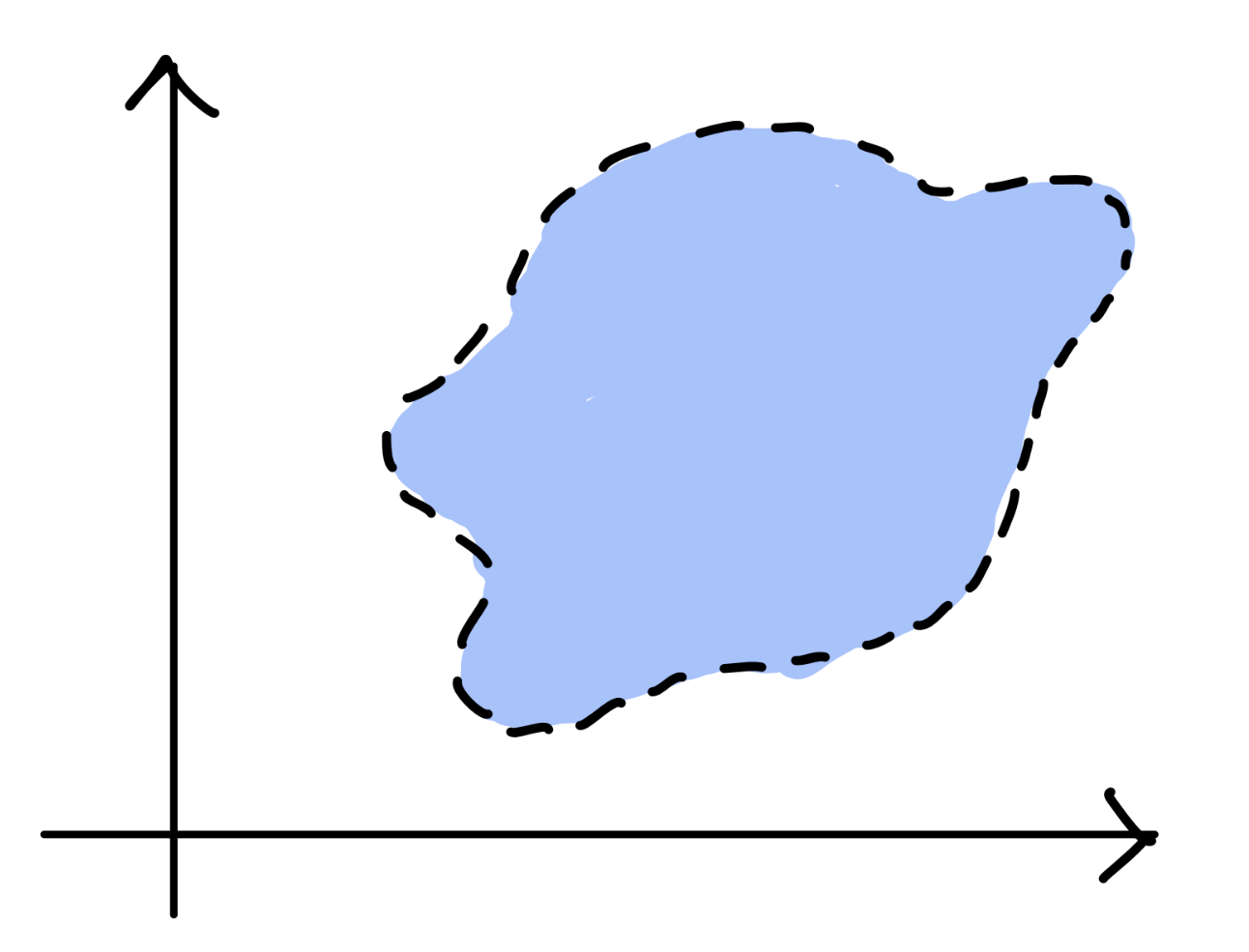
Here’s what I want you to visualize when I say “open set”:
This is a blob with the insides filled in, but not including the boundary.
defining this precisely
A subset U of R2 is open if for every point p in U, there is an open ball B containing p (of some radius) such that B is contained in U.
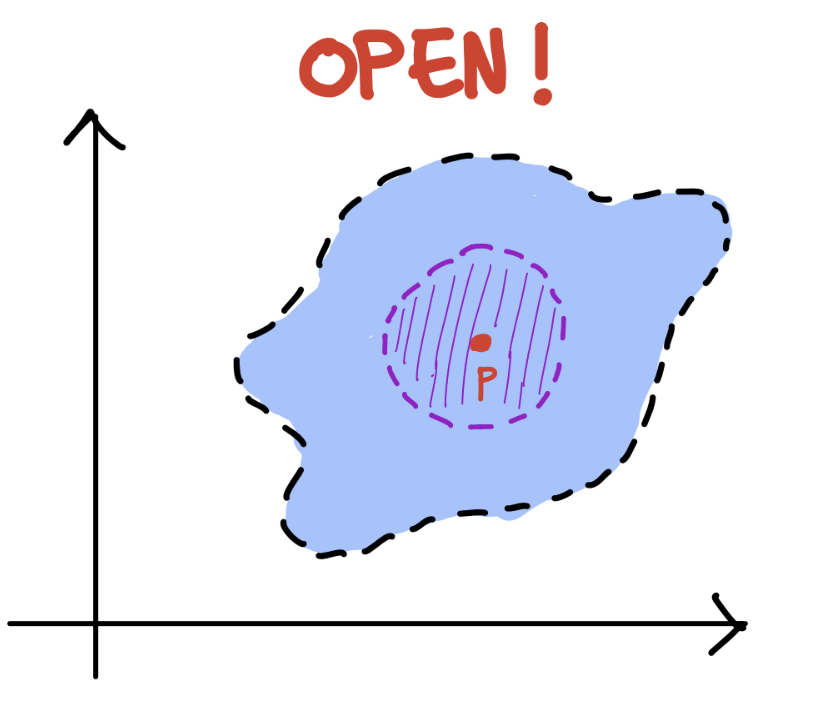
Intuitively, as p moves closer and closer to the boundary of the set, the open ball B containing it would have to get smaller and smaller.


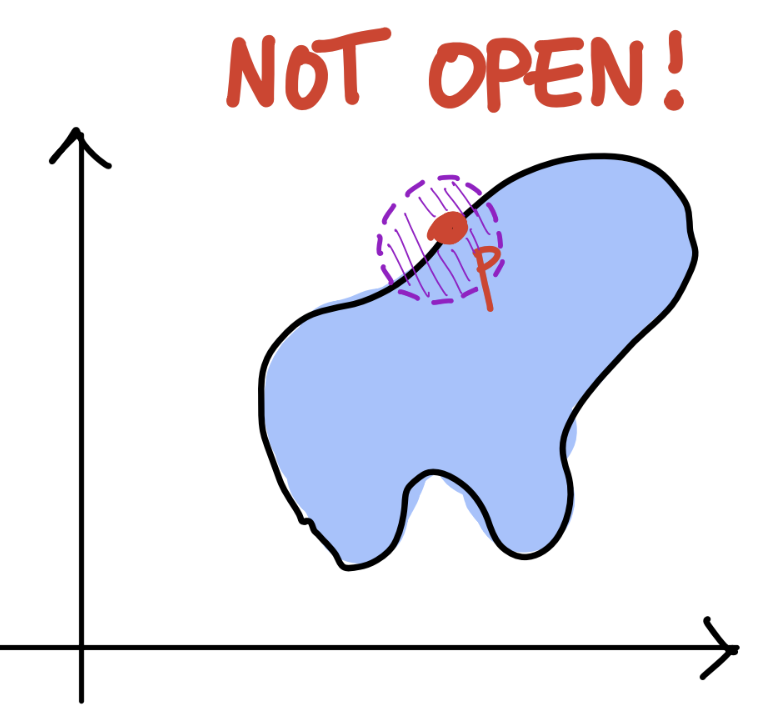
this is not an open set
This set (containing its boundary) not be open since for the point on the boundary, no open ball containing it would be contained inside the set.
properties of open sets
Here are the three most important facts about open sets:
1. Any union (even infinitely many!) of open sets is open. (Why? If a point lies in the union, it lies in at least one of the sets, which gives you a valid open ball.)
2. The intersection of finitely many open sets is open. (Here’s why: a point in the intersection is inside each individual set, and you can take the smallest of the corresponding radii.)
3. The entire plane R2 is open. And by convention, the empty set is open.
so what’s a topological space?
The notion of an open set is very useful. It comes up so often that we abstract it out into a so-called topological space.
A topological space is a set X together with a collection T of subsets of X (called open sets) such that:
Arbitrary unions of sets in T are in T.
Finite intersections of sets in T are in T.
The empty set and X are in T.
The pair (X,T) is called a topological space.
some examples:
As an example, R2 is a topological space, where the open sets are the ones that we’ve been discussing. (This is called the standard topology on R2.)
Another example is the discrete topology: where every subset is declared to be an open set.
On the other extreme is the trivial topology: where only the empty set and the whole space are open.
problem of the week
Find the smallest prime that is the fifth term of an increasing arithmetic sequence, all four preceding terms also being prime.
Got a solution to the challenge problem? Submit it here.
See here for the solution to last week’s problem. Shoutout to Pedro (New Jersey) whose very nice solution is being featured this week.
Thanks and happy learning,
Adithya