
vector spaces, explained
the core concept in linear algebra

In math, it’s very common to see two objects that look superficially different on the outside, but are actually the same on the inside.
We’ll look at two such examples in this post:
the 2-D plane
the set of real-valued continuous functions on [0,1]
These two objects look different but actually have a deep underlying similarity.
Rather than studying each object in isolation, we’ll define a general structure that captures what they have in common. Once you define that structure, you can prove theorems that apply to all such objects at once.
That structure is called a vector space.
In this post, we’ll dive into what that is.
meet: the 2-dimensional plane
In the picture here, I’ve highlighted two elements in the plane.
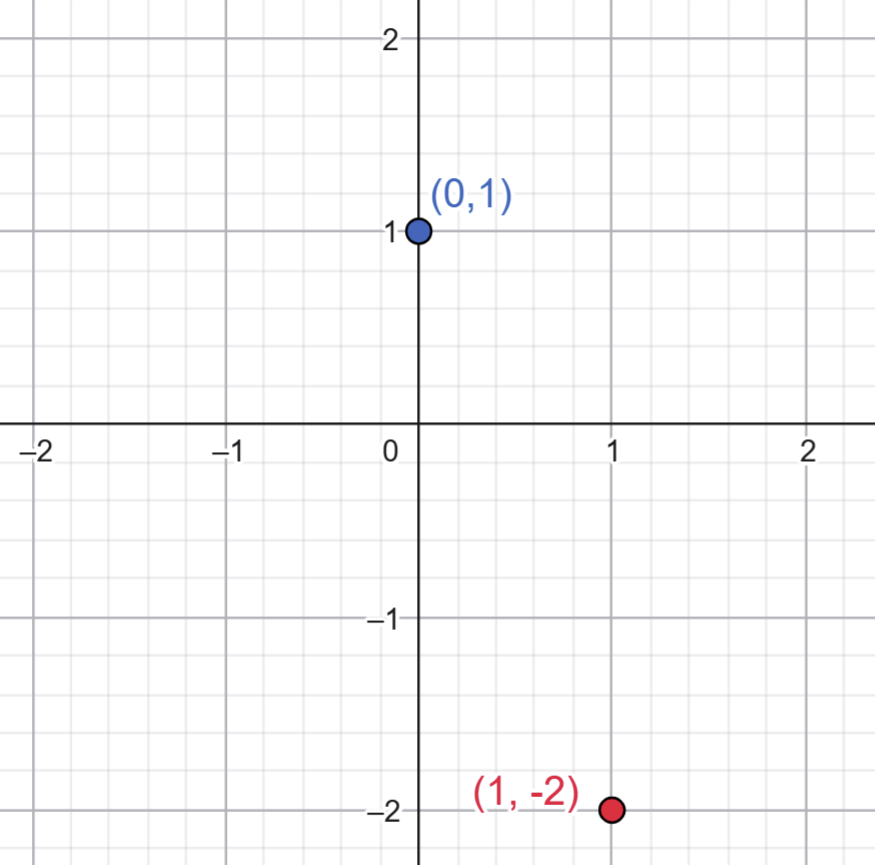
It has certain properties that we know and love.
(Closed under addition) Given two points in the plane, we can add them (coordinate-wise), and their sum is still in the plane
(Closed under scalar multiplication) Given a point in the plane, we can scale it by a real number. This scaled element is still in the plane.
(Zero element) There is a “zero element”, namely the point (0,0). If you add it to any element, it does nothing.
(Additive inverses) Every point in the plane (a,b) has an additive inverse, namely (-a,-b). If you add them together, you get zero.
You might say: “Adithya, these properties are obvious! Why make such a big deal out of them?”
And you’re absolutely right: they are obvious. But it turns out that many objects in math satisfy the same properties, many of which look quite different from the plane!
now meet: continuous functions
Consider the set of all continuous functions from [0,1] to the real numbers:
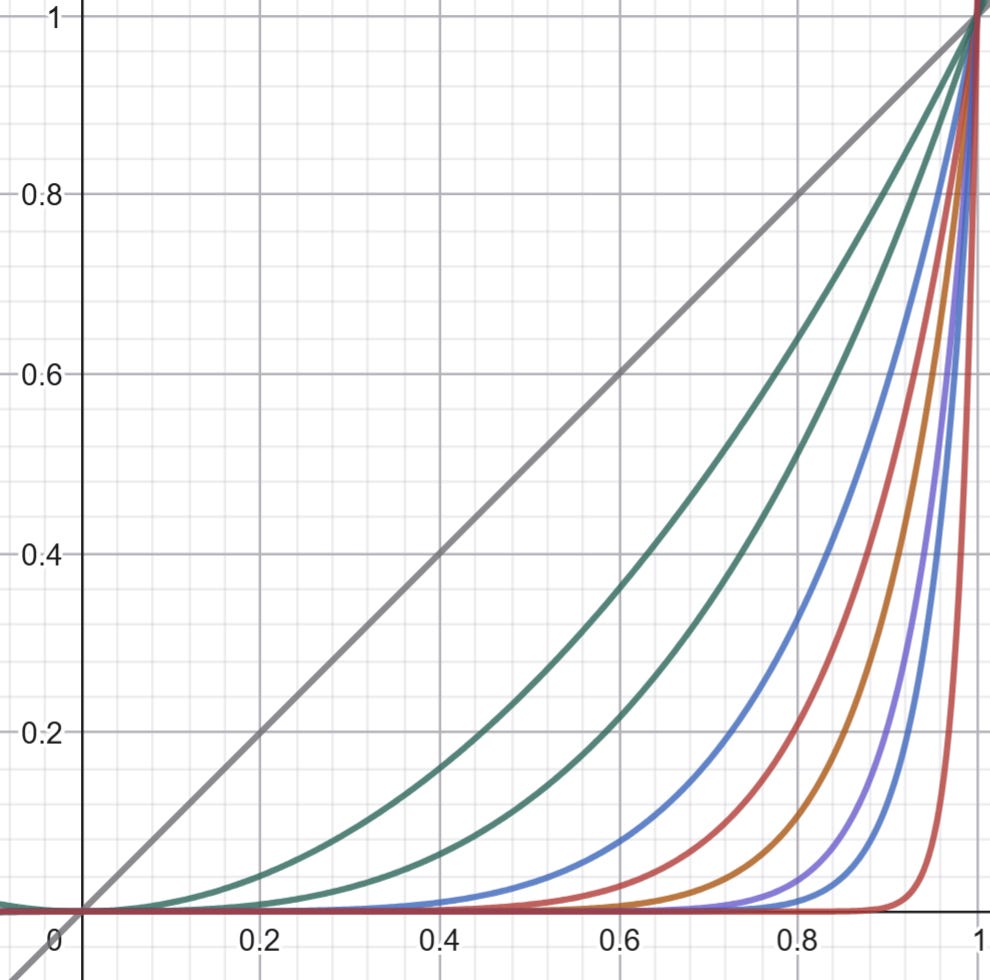
This set also satisfies certain very nice properties:
(Closure under addition) If you add two continuous functions on [0,1], the sum is a continuous function on [0,1].
(Closure under scalar multiplication) If you multiply a continuous function on [0,1] by a constant, you get a continuous function on [0,1].
(Zero element) There is a “zero element”, namely the zero function. If you add it to any function, it does nothing.
(Additive inverses) Every continuous function f has an additive inverse, namely -f. If you add them together, you get the zero function.
so what’s a vector space?
These two examples come from different areas of math … but they have the same underlying structure. Mathematicians realized that instead of studying these objects separately, we could make one general definition that encapsulates both of them.
A vector space is a set V with the following properties:
(Closure under addition) If two elements belong to V, then their sum also belongs to V.
(Closure under scalar multiplication) If v belongs to V, then cv also belongs to V for any real number c.
(Additive inverse) Every element has an additive inverse.
(Zero element) There exists a “zero element”, denoted 0. Its property is that
Disclaimer: There are a few other (easy) axioms that I’m leaving out to avoid making this article too long, but if you’re interested, you can see all the axioms laid out in full in the second section of this article for the full definition.
what’s something that’s not a vector space?
Consider this blue circle inside the plane, centered at the point (1,1).
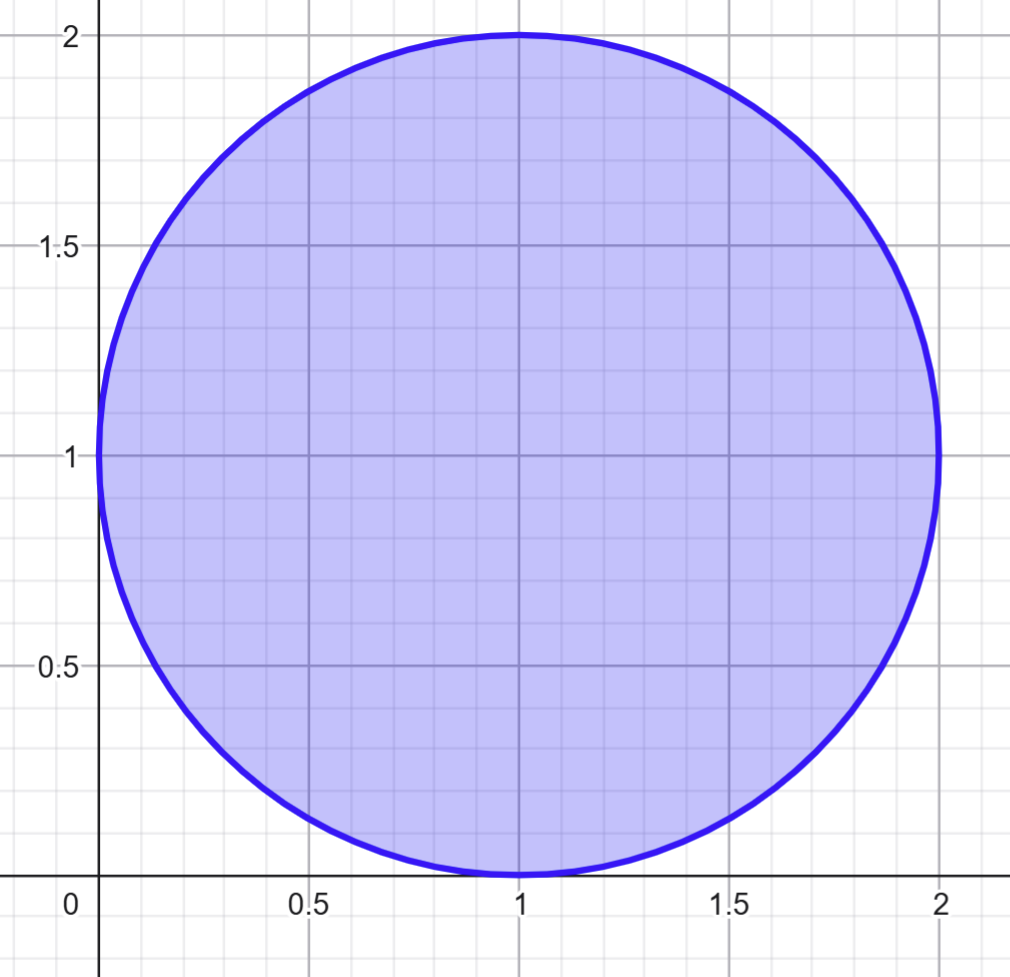
This is not a vector space. Why? It doesn’t satisfy a lot of the axioms!
It doesn’t contain zero!
It’s not closed under addition. (Why? Can you find two points in the circle whose coordinate-wise sum isn’t in the circle?)
It’s not closed under scalar multiplication (Why?)
problem of the week
Find the number of ordered pairs (x,y) of positive integers that satisfy
Got a solution to the challenge problem? Submit it here.
See here for the solution to last week’s problem. Shoutout to Etan (New York) and Henry Díaz Bordón (Madrid, Spain) for submitting solutions to last week’s challenge problem.
Thanks and happy learning,
Adithya
Was the challenge problem intended to be the same as May 13?